


From the scorching deserts of Saudi Arabia to the bustling ports of Dubai, a quiet revolution is reshaping the commercial landscape. A new fleet of workhorses, bearing the badges of Shacman, HOWO, and other Chinese manufacturers, is steadily becoming the backbone of industry, signaling a profound shift in one of the world’s most strategic vehicle markets.DUBAI, UAE – In the vast, sun-baked logistics yard of Jebel Ali Port, the cacophony of commerce is relentless. Container handlers beep, cranes whir, and the deep-throated growl of diesel engines provides a constant bassline. For decades, that growl was almost exclusively the sound of European, American, and Japanese powertrains. But today, a new chorus is rising. Sleek, modern trucks with bold Chinese characters next to their model names are lining up alongside their Western counterparts, hauling containers, construction materials, and the very infrastructure of the modern Middle East.This is not a fleeting trend but a calculated, strategic incursion. Chinese commercial vehicle manufacturers, having honed their expertise and built immense scale in the world’s largest automotive market, are now setting their sights on global dominance. The Middle East, with its booming construction, logistics, and oil and gas sectors, represents a prime target. And they are winning market share not with flashy gimmicks, but with a compelling, value-driven proposition that is resonating with cost-conscious fleet operators across the region.
The primary driver behind this seismic shift is an undeniable value equation. A flagship tractor unit from a European manufacturer can easily command a price tag 50% to 80% higher than a comparable HOWO TRUCK from Sinotruk or a robust Shacman truck from Shacman International.”For a fleet operator, the math is simple,” explains Ahmed Al-Mansoori, who runs a mid-sized logistics company in Dubai. “I can buy two HOWO TRUCKS for the price of one premium European model. The initial investment is lower, and if the Chinese truck can reliably do 80% of the job for 60% of the cost, it becomes an irresistible business decision, especially for specific applications like intra-city container haulage or construction dumps.”This value extends beyond the sticker price. Chinese manufacturers have become adept at understanding the specific needs of regional customers. They offer a wide array of configurations tailored to Middle Eastern conditions: powerful air conditioning systems to combat the extreme heat, massive radiator and cooling packages for desert operation, and corrosion-resistant coatings for trucks operating in the harsh, saline environment of the Gulf.”The one-size-fits-all approach doesn’t work here,” says Li Wei, Regional Director for Sinotruk in the Middle East. “We have dedicated engineering teams that work on adaptations. A HOWO TRUCK destined for the sand dunes of Saudi Arabia has different filtration systems and chassis reinforcements compared to one operating on the paved highways of Oman. This localization is key to our success.”
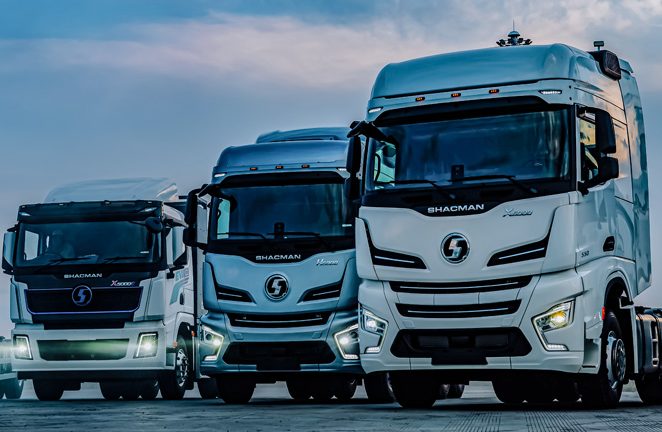
The initial foray of Chinese trucks into global markets over a decade ago was often marred by perceptions of poor quality, questionable reliability, and non-existent after-sales support. These perceptions are now the biggest hurdles that companies like Shacman and Sinotruk are working tirelessly to overcome.”The ghost of ‘cheap and cheerful’ still haunts us in some boardrooms,” admits a sales executive for a Chinese brand, who asked not to be named. “But we are no longer the companies we were in 2010. Our quality control, our use of global supply chain partners, and our manufacturing precision have improved exponentially.”To combat skepticism, manufacturers are investing heavily in building a robust physical presence. This means establishing sprawling parts warehouses and state-of-the-art service centers in strategic hubs like Dubai, Dammam, and Kuwait City. The promise is not just a cheap truck, but a supported one.Shacman, for instance, has made “Service First” a cornerstone of its international strategy. “A truck is not a phone; it can’t be down for a week waiting for a part to ship from China,” says Karl Richter, a German engineering consultant working with Shacman in the UAE. “We have a central parts depot in Dubai with over 50,000 SKUs, guaranteeing 24-hour availability for 95% of common parts. This logistical backbone is what gives fleet managers the confidence to buy.”Furthermore, Chinese brands are aggressively offering warranties that often surpass those of their established competitors. A standard 3-year/unlimited-kilometer warranty on a Shacman truck is a powerful marketing tool when pitched against a European rival’s more limited coverage.