


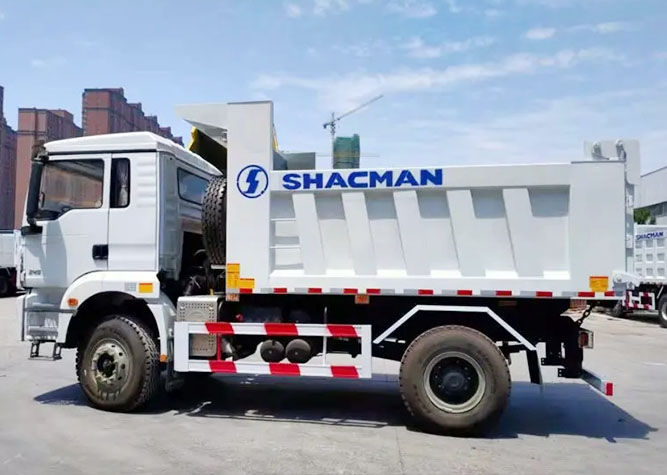
While several Chinese brands are making inroads, two names have become synonymous with this market push: HOWO and Shacman.Sinotruk’s HOWO TRUCK: Often dubbed the “flagship invader,” the HOWO series from China National Heavy Duty Truck Group (Sinotruk) was one of the first to gain significant traction. Known for its rugged construction and powerful powertrains, often leveraging licensed or co-developed technology from industry giants like Mercedes-Benz Truck and Volvo in its earlier days, the HOWO TRUCK found an early niche in the heavy-duty construction and mining sectors. Its brawny image and ability to handle severe overload conditions made it a favorite for tipper and mixer applications. Today, the HOWO brand has evolved into a full-fledged family, offering everything from lightweight distribution trucks to premium long-haul tractors that directly compete with European models.Shacman Truck: Born from a long-term partnership with German giant MAN, Shacman has leveraged this technical collaboration to build a reputation for reliability and durability. The Shacman truck is often perceived as the “balanced choice,” offering a blend of European-inspired engineering—evident in its cab design and chassis architecture—with Chinese cost efficiency. Shacman has been particularly successful in the general freight and logistics segment, where operators seek a dependable workhorse without the premium brand price. Their focus on fuel efficiency, a critical factor given regional fuel prices, has won them many converts.”The Shacman truck we purchased three years ago has surprised us,” says Omar Farooq, a fleet manager for a large Saudi construction firm. “The running costs are manageable, the fuel consumption is competitive, and most importantly, the drivers appreciate the comfortable and well-appointed cabin. It has changed our entire procurement strategy.”
The rise of Chinese trucks cannot be divorced from the larger geopolitical and economic framework, most notably China’s Belt and Road Initiative (BRI). This colossal infrastructure program has financed and built ports, railways, and industrial zones across the Middle East and Central Asia. And what is used to build and supply these projects? Trucks.”Where Chinese engineering and construction companies go, Chinese trucks inevitably follow,” notes Dr. Aisha Al-Sayed, a political economist specializing in Sino-Middle Eastern relations. “It creates a closed-loop ecosystem. A Chinese state-owned enterprise wins a contract to build a power plant in Iraq or Egypt, and it often sources its equipment—including its fleet of hundreds of dump trucks and concrete mixers—from Chinese suppliers like Sinotruk and Shacman. This provides a guaranteed initial market and serves as a massive, rolling advertisement for their durability.”This symbiotic relationship provides an unparalleled market-entry advantage, allowing Chinese trucks to prove their mettle in the most demanding real-world conditions before being offered to the general public.
Despite the rapid progress, the journey is far from over. Chinese manufacturers still face significant challenges.Brand Perception: Overcoming the final bastion of brand snobbery is their ultimate challenge. For many large, premium fleet operators and owner-drivers, a European truck is still a status symbol, an investment in a brand known for its high residual value and unparalleled driver comfort.Residual Value: This remains a critical weakness. A three-year-old European tractor can retain up to 60-70% of its value, while a comparable Chinese model might struggle to hold 40-50%. This higher rate of depreciation impacts the total cost of ownership calculations.The Electric Horizon: The global shift towards sustainability is also reaching the Middle East. Chinese manufacturers, who are leading the electric vehicle revolution at home, see this as their next great opportunity. Companies like BYD are already deploying electric buses in the region, and the logical next step is electric trucks for last-mile logistics and port operations. Their vast experience and scale in battery technology could allow them to leapfrog competitors in this emerging segment.”The game is changing,” concludes Li Wei from Sinotruk. “We are no longer just the ‘value option.’ With our new generation of models, featuring autonomous driving aids, connected vehicle technologies, and fully electric powertrains, we are becoming the ‘technology and value option.’ We are here for the long haul.”In the sprawling yard at Jebel Ali, the evidence is irrefutable. The deep burgundy of a HOWO TRUCK and the bright green of a Shacman truck are no longer unusual sights; they are part of the fabric. They represent a fundamental recalibration of the global automotive order, one driven by pragmatism, persistent improvement, and a strategic vision that stretches far beyond the showroom. The Silk Road, once traversed by camels, is now dominated by these modern steel camels, and they are just getting started.